Framework
THE METHODOLOGY
Capital architecture is the systematic design of layered capital structures - optimising the type, sequencing, and pricing of capital to make a mandate bankable, replicable, and scalable.
The Capital Architecture Framework is a seven-stage practitioner methodology. It converts a financing need into a capital structure that works - across mandate types, geographies, and market cycles.
DEFINITION
A methodology, not a model. A lifecycle, not a checklist.
Conventional finance practice generates capital structures through precedent, intuition, and iterative negotiation. The result is bespoke, opaque, and difficult to replicate. One transaction does not reduce the cost of the next.
The Capital Architecture Framework takes a different position: capital structure design is a discipline with systematic stages, explicit decision rules, and documented outputs. Each stage conditions the next. No stage may be skipped. The result is a structure that can be understood, audited, stress-tested, and, critically, replicated.
The CAF is built on three foundational concepts:
Structural equivalence. Catalytic capital absorbs market failures identically across geographies. A concessional first-loss tranche works in German industrial decarbonisation for the same structural reasons it works in sub-Saharan energy infrastructure. The mechanism is not geography-dependent. The framework is therefore not sector- or market-specific.
The Architecture Gap. The OECD identifies blended finance as a cottage industry of largely bespoke, fragmented interventions. After a decade of institutional engagement, the market has not generated the standardised, replicable instruments required for deployment at systems scale. The CAF is the direct response to that gap.
Minimum Concessionality. Concessionality - capital that accepts below-market returns in exchange for mandate alignment - must be reduced to the minimum level required to achieve structural viability. Structural generosity increases mobilisation cost and restricts replicability. The CAF requires at least two iterations of concessionality at Stage 2 to confirm the optimum.
THE STAGES
From diagnosis to governance. Seven stages. Every stage outputs. No stage optional.
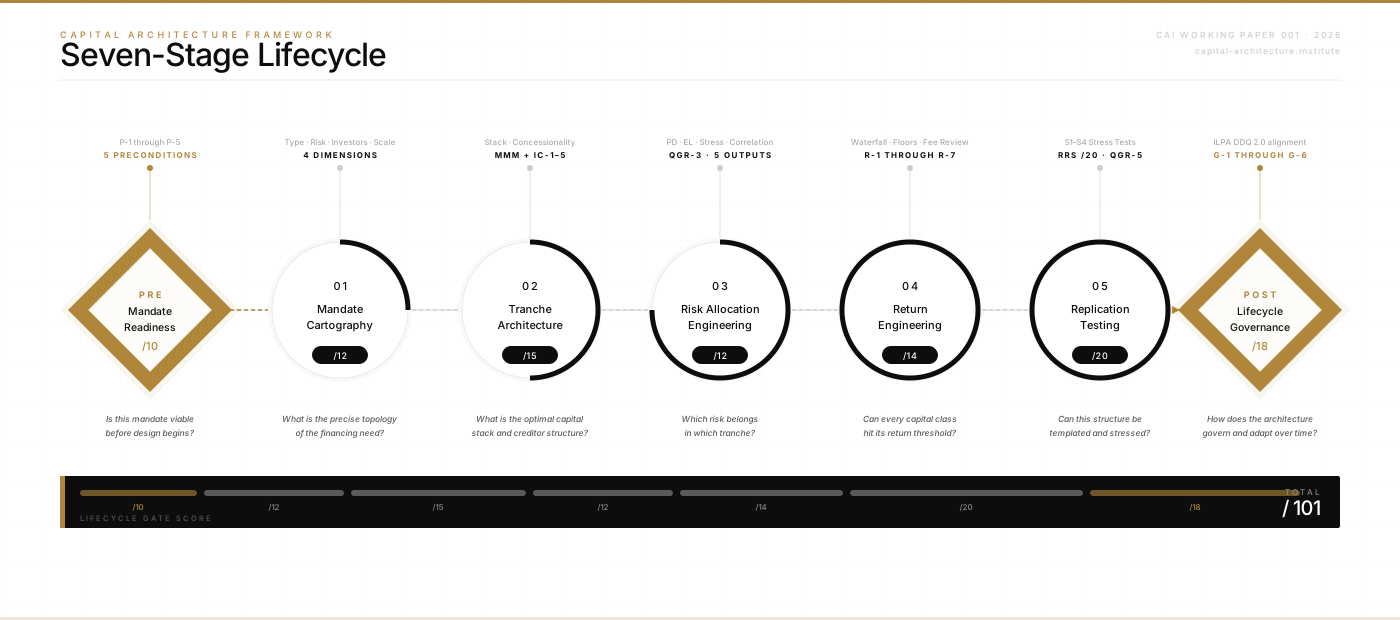
PRE-STAGE - Mandate Readiness Assessment
Governing question: Is this mandate architecturally viable before design resources are committed?
Five preconditions (P-1 through P-5) scored 0/1/2. Total scored /10. Gate decisions: Hold (<5) · Remediate (5–7) · Proceed (8–10).
The MRA exists because capital architecture design is resource-intensive. Investing significant practitioner time in a mandate that fails on precondition P-1 (identifiable market failure) or P-3 (catalytic capital availability) is a waste of resources. The MRA filters the mandate before design begins.
Key outputs: P-1 through P-5 scores · MRA total /10 · Gate decision · Remediation actions
STAGE 1 - Mandate Cartography
Governing question: What is the precise topology of the financing need by type, risk, investor universe, and replication potential?
Four dimensions: Capital Need Type (Transition / Scale / Bridge / System) · Risk Topology (8 categories) · Investor Universe (Confirmed / Likely / Speculative) · Replication Potential. Scored /12.
Cartography establishes the exact shape of the problem before any solution is designed. Architects who skip this stage consistently over-engineer structures for risks that do not exist and under-engineer for risks that do.
Key outputs: Capital Need Type classification · Risk Topology map · Investor Universe matrix · Replication Potential score
STAGE 2 - Tranche Architecture
Governing question: What is the optimal capital stack - and how are creditor rights, enforcement, and distribution structured?
Capital Stack construction · Mobilisation Multiplier Model (MMM) · Minimum Concessionality iterations (minimum 2) · Intercreditor Architecture decisions IC-1 through IC-5. Scored /15.
The capital stack defines who bears which risk at what return. The MMM measures structural efficiency - how much private capital is mobilised per unit of catalytic capital. The intercreditor architecture specifies the contractual rules that govern the stack: payment waterfall, enforcement rights, cure rights, PIK toggle mechanics, and liability management.
Key outputs: Capital stack with tranche allocations · MMM calculation · Concessionality iteration log · IC-1 through IC-5 decisions
STAGE 3 - Risk Allocation Engineering
Governing question: Which risk belongs in which tranche - and what quantitative outputs must the risk model produce?
Risk Attribution Matrix (12 categories) · QGR-3 five outputs: Probability of Default · Expected Loss · Stress Coverage Ratio · MMM confirmation · Correlation coefficients. Scored /12.
Risk allocation is the most technically demanding stage in the framework. It requires both a qualitative attribution decision - which tranche bears which risk - and quantitative validation that the attribution is coherent. The QGR-3 gate cannot be passed without five specific numerical outputs.
Key outputs: Risk Attribution Matrix · QGR-3 sign-off (PD · EL · Stress Coverage · MMM confirmation · Correlation)
STAGE 4 - Return Engineering
Governing question: Can each capital class achieve its threshold return simultaneously, across the full lifecycle?
Return architecture per tranche · Seven principles R-1 through R-7 · Waterfall mechanics · Return floors · Fee conflict review. Scored /14.
Return engineering is the stage where structural viability is confirmed at the investor level. It is insufficient to demonstrate that the structure produces aggregate returns. Each capital class must achieve its threshold return simultaneously - and the waterfall mechanics, return floors, and fee structures must not create irreconcilable conflicts between LP classes.
Key outputs: Per-tranche return architecture · R-1 through R-7 checklist · Fee conflict analysis · Return floor schedules
STAGE 5 - Replication Testing
Governing question: Can this structure be templated - and does it survive late-cycle and regulatory stress?
Replication Readiness Score (RRS) /20 · Four stress scenarios S1 (credit cycle compression) · S2 (regulatory change) · S3 (mandate failure) · S4 (LP withdrawal) · QGR-5 pass/fail thresholds. Scored /20.
A structure that works in base case conditions but fails in stress is not an architecture - it is a bet. Stage 5 subjects the structure to four stress scenarios that represent the realistic range of late-cycle and market disruption conditions. Structures that fail QGR-5 return to Stage 2 for redesign.
Key outputs: RRS /20 classification · S1–S4 stress test logs · QGR-5 pass/fail · Template classification
POST-STAGE - Lifecycle Governance
Governing question: How does the architecture adapt over time - meeting institutional LP governance standards throughout deployment?
Six governance mechanisms G-1 through G-6 · ILPA DDQ 2.0 alignment mapping · Trigger architecture · Replication feedback loop. Scored /18.
Governance is not administration. It is the architecture through which the structure maintains its design integrity across the full deployment lifecycle - as market conditions change, LP requirements evolve, and mandate execution diverges from base case assumptions.
Key outputs: G-1 through G-6 governance mechanism documentation · ILPA DDQ 2.0 alignment map · Trigger schedule · Replication feedback
GOVERNANCE REQUIREMENTS
The framework has hard gates. Stages cannot be passed by assertion.
The CAF operates two quantitative gate requirements - QGR-3 (Stage 3) and QGR-5 (Stage 5) - that require specific numerical outputs before the next stage may proceed.
QGR-3 requires five outputs:
Probability of Default per tranche · Expected Loss calculation · Stress Coverage Ratio (minimum 1.3× in base case) · MMM confirmation vs. Stage 2 design · Correlation coefficient between tranche risk exposures
QGR-5 requires five pass/fail thresholds:
Senior tranche survival in S1 credit stress · Junior tranche survival in S2 regulatory stress · Mandate continuation feasibility in S3 failure · Structural integrity under S4 LP withdrawal · RRS /20 minimum 12 for template classification
These requirements exist because capital architecture failure is not an abstract outcome. It is pension capital losing value, development mandates remaining unfunded, and institutional trust in the asset class eroding. The gates are designed to prevent structures from reaching LP capital with unresolved design flaws.
THE FRAMEWORK IN USE
The CAF has been applied to mandate structures from EUR 80 million to EUR 500 million+ across four domains.
Energy Transition - German industrial decarbonisation · EUR 200m · KfW subordinated first-loss · Senior pension LP at 4.5–5.5% · MMM 4.7× · SFDR Article 9 structure
Defense and Dual-Use - European dual-use venture debt fund · EUR 100m · EDF/BMBF grants as synthetic first-loss · Institutional LP senior tranche 8–11% + warrant coverage · AIFMD II LO-AIF compliant
Social Infrastructure - UK affordable housing portfolio · GBP 150m · Homes England viability gap funding · LGPS subordinated mission capital · Pension senior at 4–5.5% · 20-year tenor
Deep Tech Venture Lending - EUR 80m full lifecycle application · RRS 16/20 · QGR-3 and QGR-5 documented · Template classification achieved
All mandate descriptions are illustrative and based on the CAF working methodology.
PUBLISHED TOOLING
The methodology ships with tools. All free under CC BY-NC 4.0.
CAF Working Paper 001
The complete theoretical and methodological foundation. Seven stages documented. Five formal propositions. Quantitative governance requirements. Global North application framework. 50+ pages.
CAF Practitioner Manual
Stage-by-stage working tool. Scored checklists, worked examples across four domains, QGR specifications, stress calibration data, regulatory mapping (SFDR 2.0 · AIFMD II · ELTIF 2.0). 80+ pages.
CAF Project Assessment Workbook
Nine-tab Excel workbook. 87 live formulas. Gate decisions formula-driven. Five-project comparison matrix. Architecture Readiness Band /101.
All publications: CC BY-NC 4.0 · Free for non-commercial use · Commercial licensing on request.
Start with the framework. The tools are ready.
Capital Architecture Institute · wait, what. · Zurich
capital-architecture.institute · cai@wait-what.co
All CAI publications CC BY-NC 4.0 · Free for non-commercial use